Sunday, 13 November 2016

Act 3 scene 3 BIG QUESTION 3


I had rather be a toad
And live upon the vapour of a dungeon
Than keep a corner in the thing I love
For others' uses. (3.3.274-278)

  1. How does this scene relate to Othello and hubris (excessive pride - part of the tragic elements)? How might Othello's pride mean he is more concerned by Iago's suggestions about his wife's possible infidelity? Consider:
    1. How he reacts to Iago's suggestions once Iago has left, and what he says about Desdemona (262-281)
    2. How Othello may feel, knowing that Iago seems to be holding back information about Desdemona - it seems like Iago knows something he does not

Act 3 scene 3 BIG QUESTION 2


She did deceive her father, marrying you,
And when she seemed to shake, and fear your looks
She loved them most. (3.3.209-211)

For she had eyes and chose me. (3.3.192)
  1. How do ideas about difference and otherness help Iago's manipulation of Othello in this scene? Consider:
    1. How Othello is reminded of the fact that Cassio helped him to woo Desdemona (lines 70-74) (Remember, Othello is insecure about how he speaks compared to Italian people 'rude am I in my speech')
    2. How Iago reminds Othello of how different he is to Desdemona (lines 232-242)
    3. The reasons Othello thinks that Desdemona may fall out of love with him (lines 267-270)

Act 3 scene 3 BIG QUESTION 1


O beware, my lord, of jealousy!
It is the green-eyed monster, which doth mock
The meat it feeds on. (3.3.167-169)

These questions concern Act 3 scene 3 up to line 303.


opportunist
ɒpəˈtjuːnɪst/
noun
  1. 1.
    a person who takes advantage of opportunities as and when they arise, regardless of planning or principle.
    "most burglaries are committed by casual opportunists"

strategist
ˈstratədʒɪst/
noun
  1. a person skilled in planning action or policy. A person responsible for implementing a plan or strategy.
    "he is a cunning military strategist"


Reflect on Act 3 scene 3 so far. Do you think Iago is an opportunist or a strategist? You must give reasons for your response, with quotations from the play to support your opinion.

Monday, 24 October 2016

Act 2 scene 3

These questions apply to Act 2 scene 3, lines 1-254. Answer them in full sentences, with quotations. 
  1. Iago switches from verse to prose when he speaks with Cassio, and Cassio follows. What does this indicate about the exchange? What might it indicate about Cassio? AO2 LFS
  2. What language does Cassio use when speaking about Desdemona? How does it compare to the language Iago uses to sexualise her? Why do you think Iago is speaking about Desdemona in this way to Cassio? (lines 15-25) AO2 LF  
  3. How does Iago persuade Cassio to drink? Use your close reading skills to analyse the language he uses. (Note how ‘but’ is used as an adverb here) AO2 LFS
  4.  Why does Iago try to subvert the social order and bring others down to his level, rather than try to climb the ladder and raise himself up? Consider ideas about social order at the time AO3, context.
  5. Othello says “My blood begins my safer guides to rule/And passion, having my best judgements collied/Assays to lead the way.” (lines 201-203) What does this quotation reveal about the effects of Iago’s knavery in this scene?
       BIG QUESTION: Why is this scene important in relation to the play as a whole?
     Consider:
       How Iago is presented
      What happens in the scene
      What this scene indicates about key characters

Thursday, 6 October 2016

Writing your extract responses

In today's lesson we are going to begin writing our first piece of A Level work.


I have included two example responses to help you recognise the formality and depth required for the higher bands.

EXAMPLE ANSWERS

EXTRACT

Friday, 9 September 2016

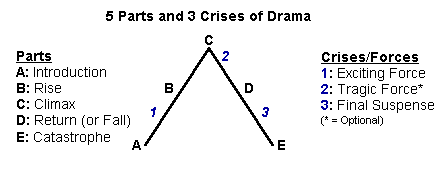
The structure of a tragedy

The images below explain the structure of a tragedy. Using this information, apply this structure to Othello and identify the events which fit this model.

Image result for structure of a tragedy shakespeare

Act I: Exposition, Exciting Force, Rising Action
Act II: Rising Action
Act III: Rising Action, Climax, Falling Action
Act IV: Falling Action

Act V: Falling Action, Catastrophe

Exposition
The exposition describes the mood and conditions existing at the beginning of the play. The time and place will be identified as well as the main characters and their positions, circumstances, and relationships to one another.

Exciting Force
Also sometimes called the complication or initial incident, the exciting force is what “gets things going.” The exciting force thus begins the conflict which will continue throughout the play.

Rising Action
The series of events leading to the climax comprise the rising action. These events provide a progressive intensity of interest for the audience. The rising action will involve more than one act.

Climax
The climax represents the turning point of the play. From this point on, the Shakespearean hero moves to his inevitable (often grisly) end.

Falling Action
The falling action includes those events occurring from the time of the climax up to the hero’s death. The episodes will show both advances and declines in the various forces acting upon the hero.

The Catastrophe
The catastrophe concerns the necessary consequences of the hero’s actions (death). The catastrophe will be characteristically simple and brief.

Critical approaches to Othello and Misunderstanding in Othello

Read the articles below and answer the guided reading questions which follow. You made need to use Wikipedia to find the definitions to some terms.

TASK 1

http://www.bl.uk/shakespeare/articles/critical-approaches-to-othello

Critical approaches to Othello

What do new historicists do?

Read the summary of Cinthio’s De Gli Hecatommithi, 1565 by clicking on the "view images from this item tab" immediately below the image of the book. Now answer the following questions

What does Cinthio's collection of short stories explore?

How does Shakespeare adapt Cinthio's tale in Othello?

Post colonialism

What is post colonialism?

What do post colonial readings focus on in the play?

What real life event was the inspiration for the plays rising action?

How does the play undercut the Christian/Turkish binary?

What are Brabantio and Desdemona fascinated by and why?

New historicist reading: ‘far more fair than black’

What debate are new historicist critics currently having?

What evidence is there that Othello was held in high esteem by other characters?

What references establish his liminal position in society?

Feminist reading: ‘a maiden never bold’

What is endogamous marriage?

What has changed in the audiences reading of the character of Desdemona since the plays original performances and the 20th century?

What is the current feminist perspective on the play?

Can you find evidence in the text to support this (include quotations)

Marxist reading: ‘’Tis the curse of service’

What are marxists critics concerned with?

What is the hierarchy (pecking order) in the play?

What have fuedal obligations of service been replaced with?


TASK 2


According to the article, where does the texts tragedy spring from?

How does Iago manipulate Othello?

The handkerchief


READ the explanation of Italian handkerchiefs to gain a better understanding of its significance.

What two things does the article believe the handkerchief represents?

What does the pattern on the handkerchief represent?

The Venetian ‘state of mind’

How does the play Othello characterise Venice?

What did the Venetians have an appetite for?

How did John Leo view Africans and why is this a significant difference to Venetian's?

War

Why does this section believe misunderstanding is inevitable?

Gender

In the play, what do Venetian men have little grasp of?

What is Emilia's function?

Summarise this section from a feminist perspective.